Node2Shell: Patch Your Homelab Tonight (CVE-2026-111497)

Companion guide and video starting point
This article is a companion to the video, not a replacement for it, and the video is the starting point for everything below.
In the video: your homelab decompresses hostile data every day, and the library doing it — Google's Brotli decoder — turned out to be a remote, unauthenticated buffer overflow. One bug lives in a dozen copies across Node.js, Bun, Python packages, Envoy, Istio, Ruby, distro libraries, and Microsoft products, so patching just one copy leaves you exposed. The video walks a six-step checklist: list every copy including inside containers, upgrade each runtime, update the system library, rebuild container images and recreate them, restart services, and re-run version checks.
Added from the sources: this guide is a distinct incident-response sequel to Node.js 24.22.1 on Ubuntu: the October Security Fix You Need — that guide is an Ubuntu install walkthrough for one patched Node release, while this one covers the cross-runtime Brotli blast radius (Node, Bun, Python, Envoy, Debian) and the find-every-copy hunt. One correction: the transcript says CVE-2026-11497 once, but the correct number is CVE-2026-111497, confirmed by the Debian security tracker. Every version number and date below was checked against the linked advisories; anything beyond the transcript and those advisories is marked untested in this guide.
What the bug is and why one patch is not enough
In the video: the flaw is a buffer overflow in the Brotli decoder file c/dec/decode.c, the code that unzips Brotli-compressed web traffic. One crafted blob sent to a server can crash it, disclose memory, or run attacker code — remote, no login, all platforms. And Brotli is not one program: Node.js bundles its own copy, so do Bun, two Python packages, Envoy, Istio, Ruby's Brotli gem, distro system libraries, .NET, and PowerShell.
Added from the sources: the overflow affects Brotli 1.0.3 through 1.2.0 and is fixed in 1.0.10, 1.1.1, and 1.2.1 per the Brotli releases. On severity, state both scores and inflate neither: Google's record scores it 9.2 CVSS v4.0 while Node.js rates it High. Qualys put the operational point bluntly — these flaws live in the runtime itself, not in your app's packages, so normal dependency scanners never flag them and you have to hunt every copy yourself, per the Qualys blog.
- It reaches you two ways: your code calling
node:zlibdirectly, or automatically whenfetch()decodes a response withContent-Encoding: br. - On the serving side, any proxy or middleware decoding Brotli request bodies will decode whatever a stranger sends.
- Think about your own stack: the self-hosted dashboard phoning home for updates, the webhook receiver, the AI gateway proxying model downloads.
Five days, end to end
In the video: the timeline moved fast — Node.js shipped emergency releases on October 21st, Imperva dropped its proof of concept on the 22nd, Python packages landed the same day, Bun and Envoy advisories plus Debian patches on the 23rd, Amazon Linux on the 24th, Microsoft on the 25th. Five days, end to end.
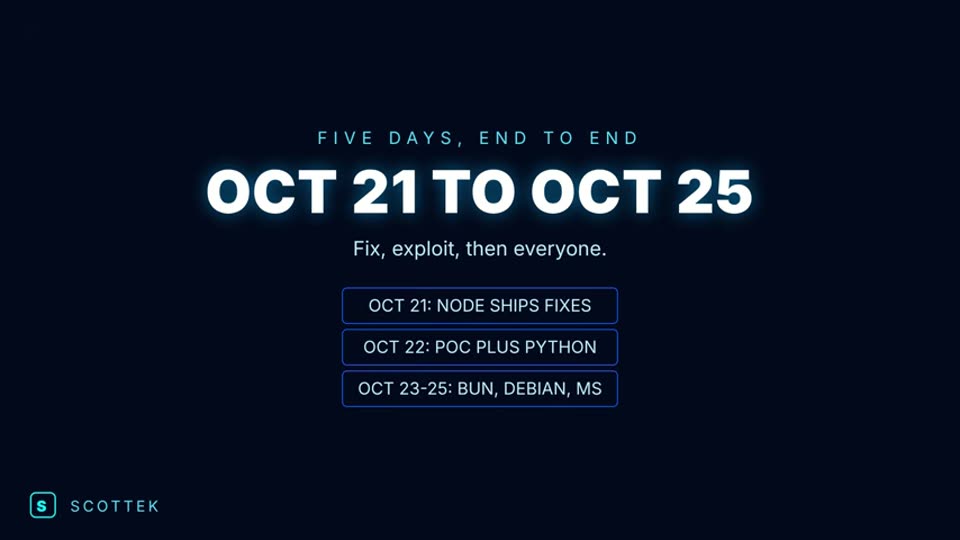
Added from the sources: the Node.js advisory confirms October 21st releases 22.23.4, 24.22.1, and 26.12.1 fixing ten flaws, four rated High, reported by OpenAI's Codex Security team. The Debian tracker confirms the CVE published October 22nd with Debian bug 1151690, DSA-6582-1 for trixie and DLA-4855-1 for bookworm, with the DSA text archived at LWN. The THN PoC coverage and the THN release coverage confirm the Imperva demonstration and the widening vendor advisories through October 25th.
Who patches what
In the video: Node 22, 24, and 26 lines move to 22.23.4, 24.22.1, and 26.12.1 — while Node 20, 23, and 25 are end of life with no fix coming ever, so you migrate this week. Bun users need 1.4.4 or later, Python needs Brotli 1.2.1 and brotlicffi 1.2.1.0, Envoy needs a fixed release in the 1.36 through 1.40 series, Istio needs 1.29.9, 1.30.6, or 1.31.2, Microsoft patched .NET, Visual Studio, and PowerShell, and Debian shipped advisories for stable and old stable.
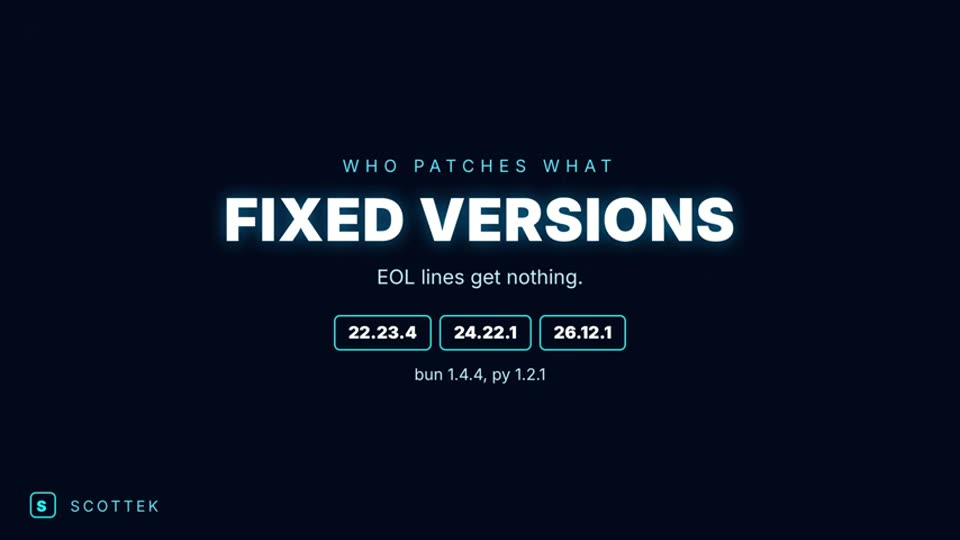
Added from the sources: the Node.js advisory is the authority for the Node pins, and the Brotli releases for the library fixes. Envoy fixed releases are 1.36.12, 1.37.8, 1.38.6, 1.39.3, and 1.40.0 — or disable the Brotli decompressor until you can upgrade. Ruby's brotli gem, distro system libraries, and Electron are also affected, so check those too.
- EOL lines (20.x and older, 23.x, 25.x) get no fix — migrate to a supported line, do not wait.
- Python shops get a bonus option: if nothing you run actually needs Brotli, uninstall it and the big HTTP libraries simply stop requesting
brresponses. - If something does need it, upgrade both packages and regenerate lockfiles so the fix sticks, and grep requirements files because transitive dependencies love to pin the old one back in.
Honesty caveats: what the exploits actually showed
In the video: an explicit honesty moment — the Imperva exploit worked on the official ARM build they tested, a second public proof of concept only managed a crash plus limited memory read on standard builds with no code execution, Python's own testing never demonstrated memory corruption at all, and as of October 22nd nobody had reported exploitation in the wild. Serious, but a patch-now story, not a sky-is-falling story. The exploit itself is never demonstrated — the video's demo uses real local version-check commands only.
Added from the sources: this matches the THN PoC coverage, which describes RCE on the official Node 24.22.0 linux-arm64 image with the fixed 24.22.1 rejecting the same input, and the THN update noting the second PoC reached code execution only on a deliberately weakened test build. Severity framing stays as stated above: Google 9.2, Node High. Exploitability beyond those reports is untested in this guide.
The loop that works: find, patch, restart, verify
In the video: finding every copy is the actual job — check runtimes with node -v, bun --version, pip show for the Brotli packages, and the system library, then check what is actually running because containers hide old runtimes. Patching binaries is only halfway: running processes keep the old vulnerable code in memory, so restart every touched service, rebuild containers on fixed base images and recreate them, and re-run version checks to confirm.
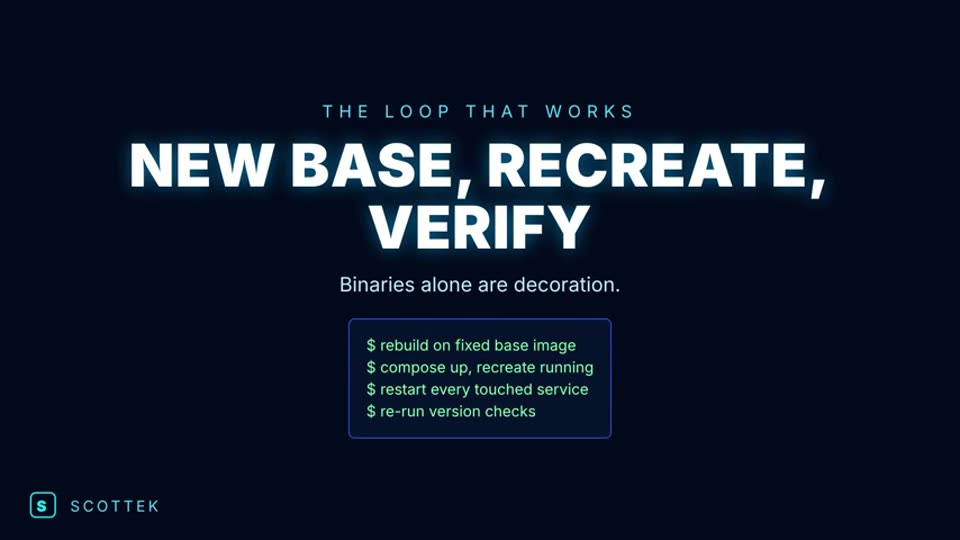
Added from the sources: the Debian path arrived as DSA-6582-1 for stable and a bookworm update for old stable, so a plain package upgrade pulls the system library fix — then restart anything linked against it, since system libraries have the same in-memory problem. Envoy and Istio operators at the edge should upgrade or switch the Brotli decompressor off until they can, since an edge proxy decoding stranger data is the worst seat in the house for this bug.
node -v/bun --version/pip show brotli brotlicffi/dpkg -l | grep brotli— find every copy.- Upgrade each runtime to its fixed release, then
apt update && apt upgradefor the system library. - Rebuild container images on patched bases and recreate the running containers — a rebuild alone changes nothing until the container is recreated.
- Restart all affected services, regenerate Python lockfiles, then re-verify every version. Do that tonight and Node2Shell is closed at every door.
Related
- Node.js 24.22.1 on Ubuntu: the October Security Fix You Need — the single-runtime Ubuntu install walkthrough this incident-response guide builds on.
- Bun Setup Ubuntu: Fast JavaScript Runtime, First Script Running — Bun setup context if your hunt finds a Bun copy to upgrade.
- Trivy Vulnerability Scanner: Ubuntu Install + First Scan — scan filesystems and images to double-check nothing still ships a vulnerable copy.