Artificial Analysis v5: 59 Beats 58 Beats 57 (10-28-2026)

Companion guide and video starting point
This article is a companion to the video, not a replacement for it, and the video is the starting point for everything below.
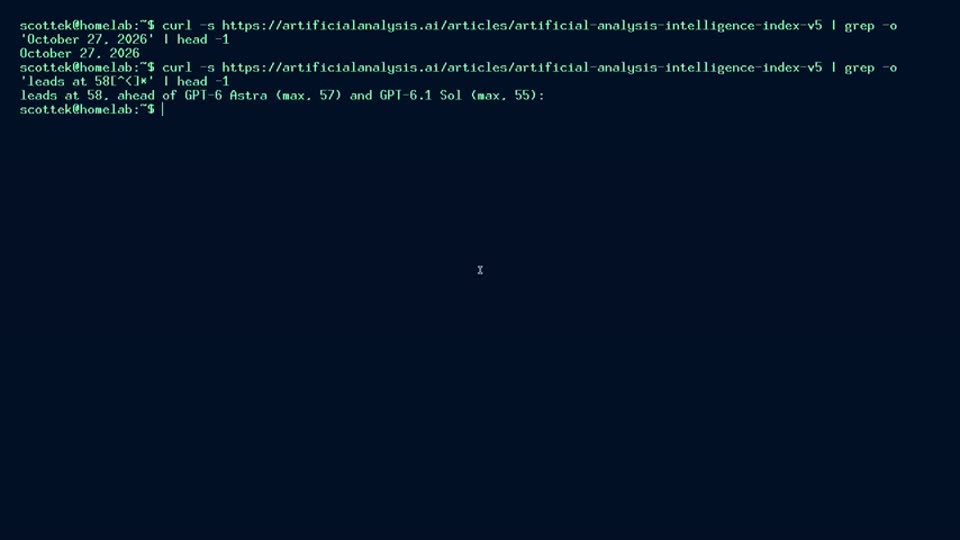
In the video: recorded October 28th, the presenter breaks down the Artificial Analysis Intelligence Index v5 across twelve beats, names the 58, 57, and 55 headline scores, walks the nine tests and four weight buckets, runs a live terminal session against the official pages, and closes with a homelab read on which models to actually run.
Added from the sources: every score below was re-checked October 30, 2026 against the official v5 announcement and the intelligence benchmarking methodology. YouTube captions were unavailable at write time after repeated rate-limited subtitle fetches, so video wording below tracks the production narration scripts from the research folder rather than a caption transcript. One score already moved after recording: Google's Gemini 4 Carbon took the v5 lead at 59 on October 28, the video's upload day, so treat the 58-57-55 order as a snapshot, not a standing result. Nothing here was benchmarked hands-on, so treat all scores as publisher-reported.
What v5 changed and why old scores are dead
In the video: v5 is the biggest overhaul since v4 launched in January, and sixty percent of the Index now runs on private test sets or held-out answers, which matters because public benchmarks leak into training data and a leaked test measures memorization, not capability.
Added from the sources: the announcement, dated October 27, 2026, confirms two brand-new tests, three upgrades, three removals, and a new scale that does not compare with v4.
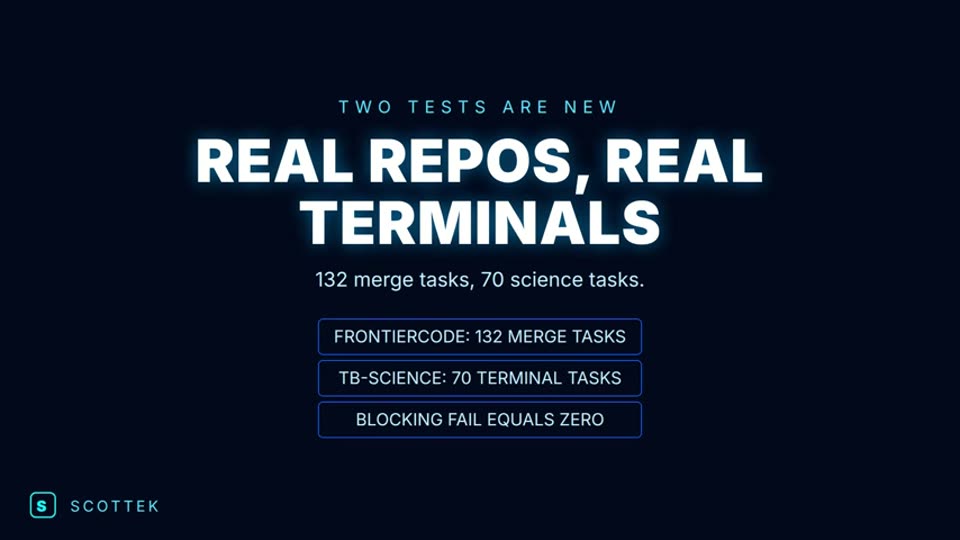
- Two tests are new: FrontierCode 2.0 from Cognition, with 132 real-repo tasks graded on whether a maintainer would merge the change, and Terminal-Bench-Science, with 70 agentic science workflows in a real terminal where a task passes only if every test passes.
- Three tests were upgraded: HLE-Diamond replaces Humanity's Last Exam with 1,000 questions split evenly between reasoning and knowledge, AA-Omniscience moves to v1.1 with saturated and leaked questions removed, and CritPt becomes a private 40-question hard subset run with a code-execution tool.
- Staying in are AA-Briefcase, AutomationBench-AA, GDP.pdf, and Terminal-Bench 4.0, while GDPval-AA v2.1, SciCode, and AA-LCR v1.1 are out.
- The nine tests sit in four buckets at 25 percent each: Knowledge Work, Coding, Science, and General, with the methodology page carrying the full per-test weights.
- Never compare a v4 score to a v5 score. For change over time, Artificial Analysis launched a separate Progress Index tracking capability since late 2022, built with Epoch AI.
Pick by workload, not by the headline number
In the video: the favorite detail is that nobody sweeps, with six different models leading the nine tests, so the best model depends entirely on your workload and coders, office grinders, and science agents should read different rows.
Added from the sources: the per-test leaders below are quoted from the v5 announcement as published October 27, 2026. Use them as a decision rule: find your workload's row first, then read that row's winner.
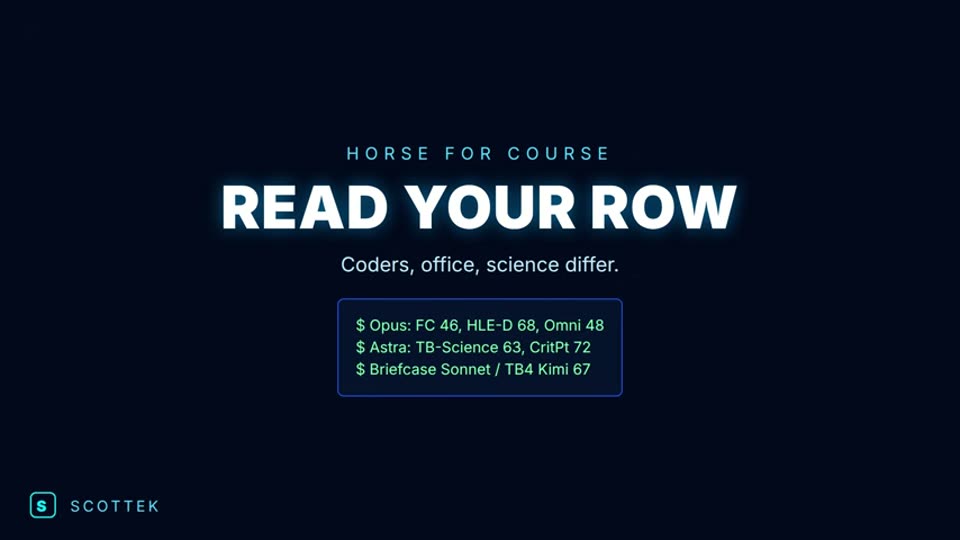
- Writing and shipping code: Claude Opus 5.5 leads FrontierCode 2.0 at 46 percent, with GPT-6 Astra, GPT-6.1 Terra, and Claude Sonnet 5.5 tied at 42 percent.
- Office and knowledge work: Claude Sonnet 5.5 leads AA-Briefcase at 1812 Elo, and Muse Wonder Full leads the GDP.pdf grounding test at 33 percent all-pass.
- Science agents in a terminal: GPT-6 Astra leads Terminal-Bench-Science at 63 percent and the CritPt hard set at 72 percent.
- Automation-style tasks: Gemini 4 Argon leads AutomationBench-AA at 78 percent, and Kimi K3.1 Pro leads Terminal-Bench 4.0 at 67 percent.
- General knowledge with low hallucination: Claude Opus 5.5 leads HLE-Diamond at 68 percent and AA-Omniscience v1.1 at 48.
- Remember the v5 limits before committing: the Index is primarily an English text suite, with image, speech, and multilingual ability benchmarked separately.
The self-host read: which open models to run
In the video: the number that should change your plans is the open-weights gap, which quadrupled from 3 points to 12, and the advice is to keep downloadable models on coding and office work while watching for Kimi's weights.
Added from the sources: the announcement confirms Kimi K3.1 Pro at 46 with weights not yet released, while the downloadable leaders, DeepSeek V4.1-Flash-1017 and GLM-5.3, tie at 32, which is 26 points behind the leader and below Claude Haiku 5.5 at 36.
- If you self-host today, the downloadable frontier sits at 32 overall, so assign local models to coding and office workloads where the gap is narrowest and keep science and hard reasoning on API models for now.
- The gap is ugliest exactly where homelab science agents would need strength: on Terminal-Bench-Science the best released-weights model scores 13 percent against 63 percent for the leader, with most open models under 10 percent.
- Watch for Kimi K3.1 Pro weights landing, since at 46 it is the only open-weights model within 12 points of the leaders, but its weights were unreleased as of October 28, 2026.
- Token appetite is your hardware bill: median output per task rose from 35k to 59k tokens, and the agentic tests carry 55 percent of the weight but roughly 90 percent of the output tokens, so size context windows and VRAM headroom for long agentic runs. This sizing logic is reasoned from the published figures and untested here.
- When you are ready to run something locally, start with Ollama plus Qwen3 on one GPU to prove your card, drivers, and memory before chasing larger open-weights releases.
Cost and effort traps before you commit
In the video: two traps close the piece, with effort settings mattering more than ever and a 13-times cost spread across the ten best models shown, plus the value call that GPT-6.1 Sol sits within 4 points of the leader at about one-eighth the price.
Added from the sources: the announcement confirms GPT-6.1 Terra at 0.96 dollars per Index task as cheapest of the top ten shown against Claude Fable 5.1 at 13.04 dollars, with Claude Opus 5.5 at 10.04 dollars and GPT-6.1 Sol at 1.27 dollars.
- Always ask which effort a score used: Opus 5.5 spans 35 at low effort to 58 at max for a 10-times cost jump, Sonnet 5.5 spans 29 points across effort levels, and Sol's spread doubled from 10 to 20 points.
- If you pay per token, the top of the chart is not where the value is: Sol within 4 points of the leader at roughly one-eighth the per-task cost is the API value play as published.
- Track the board, not the snapshot: the lead already changed hands to Gemini 4 Carbon at 59 on the video's upload day, so re-check the live Intelligence Index before choosing.
- Related guides: Ollama plus Qwen3 on one GPU for the local starting point and Hermes Agent setup for wiring a model into an agent loop once you have picked one.